Search results for tag #fediverse
![[?]](https://cdn.fosstodon.org/accounts/avatars/111/037/140/931/265/493/original/4efd2d3bf57a0bb7.jpg)
Self-Host Weekly (9 October 2026)
#Photoshop alternatives stir up controversy, software updates and launches, a spotlight on #Headplane - a web interface for #Headscale, and more in this week's #selfhosted recap!
https://selfh.st/weekly/2026-10-09/
#selfhost #selfhosting #opensource #foss #homelab #privacy #newsletter #fediverse #mastodon #ai #claude #tailscale #photopea #cloud #letsencrypt #surveys #server #sysadmin #devops #development #app #apps
![[?]](https://m-cdn.flipboard.social/accounts/avatars/109/938/986/483/500/773/original/c8d8a2545d7151ca.jpeg)
To help with their Forkiverse experiment, the Search Engine/Hard Fork teams talked to two experts: @evan and @jaz. Listen to @mike's chats with them here:
https://flipboard.video/w/nLKq9MFfyMdLaqAmHtDUWj
And here's the episode of Search Engine where they talk about why the Forkiverse is ending — rising costs, lack of exciting content, and Russian propaganda infiltration.
At the beginning of this year, @kevin, @caseynewton and @pj launched a fediverse instance, The Forkiverse. Now, they're shutting it down. Here's PJ's conversation with @mike for #DotSocial about the experiment.
![[?]](https://cdn.fosstodon.org/accounts/avatars/108/998/922/888/845/166/original/4bb3b0980c8fe06a.png)
From our series on the public funding of open source, Jeffrey A. McGuire explains how the Fediverse was built.
@nlnet @NGIZero @cwebber @spritely @Bonfire
#DigitalAutonomy #ActivityPub #Fediverse #OpenSource #community #FOSS

Alt...
© artemisdian, 123RF.com
![[?]](https://files.mastodon.social/accounts/avatars/110/641/555/278/107/926/original/60e39d3280d3b645.png)
unfollowed @OlharDigital because just saw they are using #aislop images. can’t take the risk of boosting shit that may also be written by stochastic parrots.
i usually unfollow with nary a peep, but they are a major brazilian news source on the #fediverse. when it comes to #journalism and #news sources, it’s our duty to call that shit out.
![[?]](https://files.mastodonapp.uk/accounts/avatars/109/335/469/525/883/072/original/65fca462cfdd8f42.jpeg)
![[?]](https://files.mastodon.social/accounts/avatars/113/195/343/519/584/438/original/c6a52e5e5615ef32.jpg)
Does anyone knows how to hide other Mastodon contact's activity on Friendica's timeline? If I follow any Mastodon account the timeline gets flooded with other people's posts where this contact had any sort of interaction. Is that a known bug?
![[?]](https://files.mastodon.social/accounts/avatars/117/384/379/899/857/437/original/47a3355df5dfbdcd.jpg)
Hello, #fediverse!
I’m Jeff, founder of Ola Mission, a new Arizona nonprofit preparing to bring hygiene supplies, food, clothing, and resource referrals to people experiencing homelessness in the Phoenix metro. 🌵
I’m a big fan of open source and community-powered networks, so I’m excited to build connections here.
We’re planning our first outreach in 2027. Follow along as we get started—and say hello!
![[?]](https://ftp.ieji.de/accounts/avatars/117/358/380/665/903/938/original/c82d3913bad50077.png)
Wenn ihr mögt und möchtet, wechselt ruhig auch mal die Instanz, nur Mut ... Fediverse erkunden ist gar nicht schwer, je mehr man sich damit befasst ... Es muss hier nichts super streng, linear und für immer und ewig in Stein gemeißelt laufen ... In einem dezentralen Netzwerk wie dem Fediverse ist es sogar von Vorteil auch kleinere Instanzen zu testen ... Genau wie auch verschiedene Activity Pub Dienste, je nach Bedarf (Akkoma, Sharkey, Misskey, write feely, Plume ... Naja usw ) ...
Es müssen nicht alle für immer und ewig auf einer einzigen großen Instanz rumhängen, im Fedi kann sich jedeR in alle Richtungen gerne breitmachen 😍
![[?]](https://bonfire.cafe/files/redir/local/data/uploads/01JSHXHVD56ZFCS6K7VP952TP5/icons/01JSHXMY6FMFY2PH910EQMAYK8.png)
Linux Magazine talked to us about how and why we build Bonfire.
What we want next is "not a bigger Bonfire, but a network of cooperatives covering the whole supply chain of a community's digital space", who "do it together" rather than leave you to "do it yourself".
Because "federation, we don't see it as just a technical thing. We see it as a social, economic, and political tool as well."
Link: Supporting the Social Web: How the Fediverse Found Parts for Its Platforms
Also happy to spread the love for @coopcloud@social.coop, @coquest@social.coop, @SocialCoop@social.coop and more, check out the links at the end of the article! Thanks to @horncologne@fosstodon.org for a lovely conversation, and @linuxmagazine@fosstodon.org for publishing it, in a piece that also features the great @cwebber@social.coop and @tsyesika@mastodon.nu from @spritely@social.coop.
#fediverse #ActivityPub #opensource #freesoftware #OpenCooperativeEcosystem #OpenScienceNetwork
![[?]](https://files.mastodon.social/accounts/avatars/117/316/090/855/670/477/original/3fb944ad7d07f44e.jpg)
#Gaza #Palestine #Fediverse #FediForGaza
@apenkop @soompi.com @DrALJONES @simon_brooke @wrzky @sallytheflame @karelbrits @marion_v @afewbugs
💔 @everyone 💔 Please help me and my two daughters get food for this Friday. Any donation or share could make a real difference in our lives in Gaza. 🙏❤️https://chuffed.org/project/171575-help-and-donate-to-nagham-and-her-two-daughters. ❤️
![[?]](https://libranet.de/photo/profile/fo.jpeg?ts=1779983516)
Found 55 new servers and 58 servers died off since 24 hours ago
51,734 servers checked. 1,585,586 Monthly Active Users across the fediverse
Check out the #fediverse stats
History of servers found and deleted
Find Fediverse.Observer usefull? Could use help with server hosting costs: Donate
![[?]](https://s3-eu-central-1.amazonaws.com/mastodon-aral/accounts/avatars/115/661/939/420/391/401/original/233bd09177532241.png)
Hey everyone,
@casey and @aseelfromgz had the honour of speaking to three families from Gaza today and we’d like to welcome them to Gaza Verified.
They are:
• (@hadeelfamily9)
• Nagham🍉🇵🇸 (@Nagham11)
• Julia Amal (@jojojulia)
Please give them a warm welcome to Mastodon and to the fediverse, follow their accounts, and donate to their fundraisers if you can (and please share this so others can do the same).
Also, remember that you can find all our families who have fundraisers listed at the following page, ordered by those who have received the least in donations over the last week (on a rolling basis):
https://gaza-verified.org/donate/
Thank you for making Mastodon and the fediverse a safe space for our friends in Gaza and for your support.
💕
#Gaza #Palestine #GazaVerified #Mastodon #fediverse #newMembers #verification
![[?]](https://cdn.fosstodon.org/accounts/avatars/000/110/088/original/4da529e121b6a01d.png)
We're at the final talk of the Decentralized and Federated track at @oscl
Our amazing @_elena talks about the state of social media, her Fediverse experience, and the importance of moving EU public institutions towards ethical, decentralized platforms. 🔥🔥
#OSCL26 #Oscl #digitalsovereignty #opensource #mastodon #pixelfed #fediverse #eupolicy
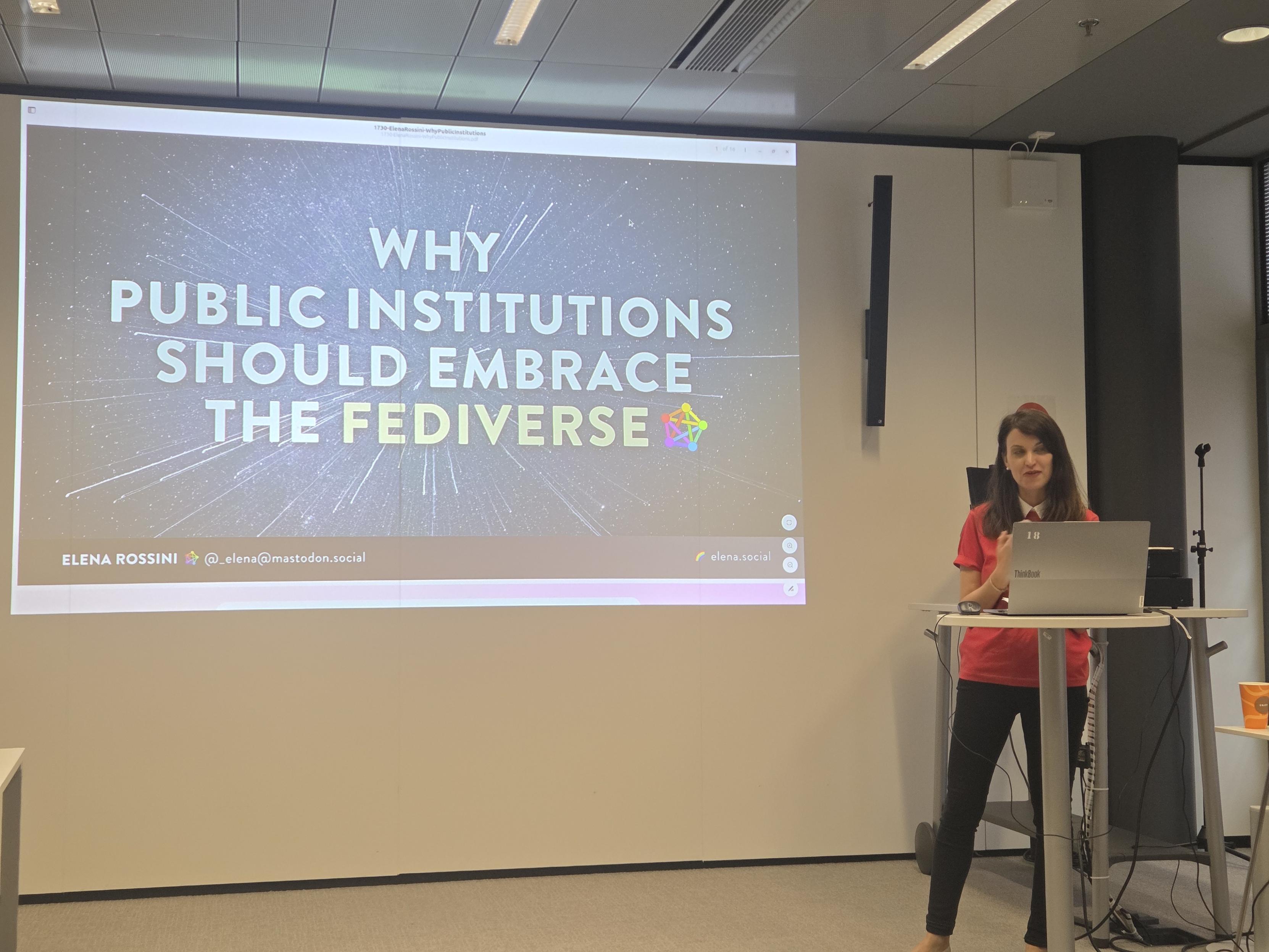
Alt...
Elena Rossini on stage with the slide saying "why public institutions should embrace the fediverse"
![[?]](https://assets.chaos.social/accounts/avatars/111/617/718/454/542/656/original/f85b2af3b7280da4.jpg)
@laurenshof is opening the "decentralized technologies" track at @oscl
Big thanks to @_elena and @Gina for hosting our track as well as to @paolo and the whole team for organising #oscl26
#opensocialweb #fediverse #socialnetworks #activitypub #opensource #opencommunications #decentralized #digitalcommons #solidarity

Alt...
Laurens is giving His Talk at oscl26 - a camera ist filming him
![[?]](https://eupolicy.social/system/accounts/avatars/115/922/644/776/520/432/original/41d1d7215b9d6414.jpeg)
Open public consultation on the EU KIDS ACT. If you have opinions about EU rules for children on social media, age verification, concerns about how this will affect the fediverse, etc... here's the best place to share them: https://ec.europa.eu/info/law/better-regulation/have-your-say/initiatives/19418-Child-online-safety-keeping-digital-spaces-accountable-and-trustworthy-EU-Kids-Act-_en
#EU #KidsAct #EUKidsAct #AgeVerification #PublicConsultation #EUHaveYourSay #fediverse #mastodon #socialMedia
![[?]](https://files.mastodon.social/accounts/avatars/000/016/041/original/737814e60c10c733.png)
Pixelfed is not for sale. It never was.
I've turned down 6 and 7 figure offers, and I'd do it again tomorrow. Some things matter more than a beach and a Peach Bellini.
We're building something generational here. Something that outlives us if we get it right.
100M+ people. Ethically sustainable. Admins and creators get paid.
You deserve better, and we're going to build it together.
![[?]](https://littleone.littlefedi.social/media/019fd149-5c36-7bce-9aa6-1cdaff7f060c/image.jpg)
Hi friends!
Now that littleFedi has been released and new instances are starting to appear, we can focus again on development and testing.
From now on, the littleFedi accounts on this instance will work like this:
The announcement - @littlefedi_official - account will be used for announcements: new releases and important communications. It will be a very low-traffic account, so I suggest following it with some attention. A new build, by the way, is not far away... 😉
There will also be an account dedicated to hints, where we will publish, notice the plural 😏, tips, tricks and useful little things about littleFedi. It does not exist yet, but I will create and announce it as soon as possible.
This account will remain more general, as it is now, although of course it will mainly talk about littleFedi.
This instance will remain our test instance. New builds and new features will be tested here before their public release.
For now, the littleFedi development model will also remain the same: the developers develop, fix, experiment and, when something is ready, a new version is released.
Open Source is freedom, not conformity.
littleFedi has its own history, its own way of growing and its own direction. We will keep following them, without trying to imitate a model just because it is the most common one in the Open Source world.
Open Source was born to let people do things differently.
littleFedi is free.
![[?]](https://social-cdn.vivaldi.net/system/accounts/avatars/109/553/464/208/348/012/original/1c9c4b7d2455a827.png)
Today, one of the world’s largest democracies, with the far right once again getting close to power, will vote for its next president.
Almost every post I see here about the global far-right movement concerns the US and Europe, or countries that directly threaten the current democratic world order and international relations. Not exactly a civilized order, but at least some are trying.
Does anyone else see a diversity problem on the #Fediverse?
And yes, at least I’m seeing some discussion of the Brazilian election on Bluesky.
![[?]](https://cdn.fosstodon.org/accounts/avatars/107/377/306/725/020/203/original/90e4e83738ce4f22.png)
So this preview not available thing is isolated to @fosstodon (when checking via mastodon.social I see previews fine). There has not been any response, so I must conclude they now block multimedia content by the automated Fediverse accounts.
#mastolivre #fediverse #activitypub #fosstodon #mastodon
Thank you, @dch@bsd.network
One of the peculiarities of littleFedi is that it was developed and tested first on the BSDs, then on illumos, and only later on Linux.
The first public instance, my own @stefano@rpi0w.stefanomarinelli.it account, runs on a Raspberry Pi Zero W with NetBSD.
I don’t think many social platforms have started out on NetBSD in recent years.
#NetBSD #FreeBSD #littleFedi #Fediverse
I want to publicly thank @dch
The FreeBSD port of littleFedi was already ready at release time, and it’s really well done.One of the peculiarities of littleFedi is that it was developed and tested first on the BSDs, then on illumos, and only later on Linux.
The first public instance, my own @stefano@rpi0w.stefanomarinelli.it account, runs on a Raspberry Pi Zero W with NetBSD.
I don’t think many social platforms have started out on NetBSD in recent years.
#ThankYou #RunBSD #NetBSD #FreeBSD #OpenBSD #illumos #OwnYourData #Fediverse #littleFedi
![[?]](https://media.bsd.cafe/bsdmmedia01/accounts/avatars/110/740/169/477/916/693/original/dfa8f1b9beefa405.png)
I want to publicly thank @dch
The FreeBSD port of littleFedi was already ready at release time, and it’s really well done.
One of the peculiarities of littleFedi is that it was developed and tested first on the BSDs, then on illumos, and only later on Linux.
The first public instance, my own @stefano@rpi0w.stefanomarinelli.it account, runs on a Raspberry Pi Zero W with NetBSD.
I don’t think many social platforms have started out on NetBSD in recent years.
#ThankYou #RunBSD #NetBSD #FreeBSD #OpenBSD #illumos #OwnYourData #Fediverse #littleFedi
![[?]](https://cdn.masto.host/socialgrowyourownservices/accounts/avatars/107/729/744/625/286/769/original/81f869582bb4abda.jpeg)
There's a new very lightweight Fediverse platform that's just been released called littleFedi. You can follow its new official account at:
Its official website including download and source code is at:
LittleFedi is intended for techy people who want to create their own Fediverse server using as few resources as possible.
It's written by @stefano (who also created the weather service FediMeteo).
![[?]](https://gts.shom.dev/fileserver/01PY645MD8EHTQHK1B35SGVAV6/attachment/original/01JJ8S6AVM71M7ATHDQ7YPEKZ7.png)
LittleFedi is an excellent light weight but fully featured Fediverse platform (ActivityPub). I've been kicking tires and providing feedback on the test instance and excited for the first release to give it a go self-hosted.
@stefano has been leading a master class in community and developer relations. He has been stewarding the team and user community with enthusiasm and transparency. Congratulations to Stefano and the team.
Here's a great story of the project's genesis and journey. https://littleone.littlefedi.social/@littlefedi_official/01a0f644-8ed6-7a7d-ade6-46f4c0a74f41
![[?]](https://s3.eu-central-2.wasabisys.com/mastodonworld/accounts/avatars/109/551/667/218/368/502/original/005a7f8b462ece71.jpg)
![[?]](https://littleone.littlefedi.social/media/01a0a91d-21e5-7701-87d0-bb53a60b6233/image.png) littleFedi - Official Account » 🌐
littleFedi - Official Account » 🌐
@littlefedi_official@littleone.littlefedi.social
The Little Computer People Present littleFedi: Our First Public Release
"Hi,
We would like to show you a small project we've built and used over the last few years.
It's a Mastodon-like platform that federates using its own protocol and can work even without HTTPS or public Internet access. Many of us have restrictions on our communications, and this project has helped us stay in touch and have our own social network. We'd love to show it to you and hear what you think, because your OwnYourData message really resonates with us."
The Story
And this email sat ignored for weeks.
It came from an anonymous, generic mailbox, with an even more anonymous and suspicious subject. The spam filter had classified it as, well, spam, for other reasons too. Only when I checked the spam folder again, weeks later, did I move it to the Inbox. "Why not?", I thought. And I asked to see what they had built.
There was no way for me to connect to one of their instances. They trusted me and sent me the code which, although fragmented and loosely put together, compiled and ran natively on FreeBSD. But before that: "We only ask you to never say anything, at least until we're ready. We don't want to be visible and, inevitably, judged or attacked. We tried something else before and backed away. Our software isn't high quality and we know it. But it works, for us, and we have fun building it. When it works we're happy, shut away in our rooms, often in the middle of the night. Sometimes, joking, we say we're like little people living inside our computers and that, thanks to this software, we can talk to each other."
At that moment I smiled and thought of a 1985 video game, from my childhood, that was quite revolutionary at the time: "You're like Little Computer People". They liked it. And that's how the group got its name: the Little Computer People.
My first test went well. I was immediately struck by the lightweight interface. "We have old computers, slow hardware. It has to be light. It just has to!". Abundance led to waste. And yet I preferred that light interface, even if incomplete, to many of today's heavy social interfaces, commercial or not. But the code had gaps, pieces held together with duct tape, unfinished parts. They knew it, they had told me, and they were ashamed of it. "You should be proud of what you're doing. It's beautiful", I wrote to them. "We'll never release it."
The battle, if we can call it a battle, was a long one. They weren't far from making it ActivityPub compatible, and there was already a basic draft implementation (tested only with snac). "We don't want to show it, we don't feel up to it. We don't want to step on the toes of others like snac or GoToSocial, who have done a far better job than we have". I tried to convince them, also because the implementation was moving forward and the results were really encouraging. But no, they didn't feel ready. Until, luckily, one of them made a proposal: "We could release it... but we don't want to be seen. We want to stay in our computers and enjoy our code. We don't want to read praise, criticism or comments. We just want to have fun. Would you like to be one of the Little Computer People too? The human who talks to humans while we keep having fun?". I felt honoured and accepted. Explaining, among other things, that Open Source is not a battle. We are not in an arena, where the existence of one solution means crushing another.
This software is not a slight against Mastodon or snac or GoToSocial, but one more choice. Nobody gains. Nobody loses. It's there. It exists. It's something beautiful, one more thing in the world. They agreed, leaving the license undecided and keeping the strictest confidentiality.
The software had no name. But after we came up with the group's name, we affectionately called it our "little social". After the first real, complete ActivityPub federation (with proper tests), the current name was chosen among the alternatives: littleFedi.
"You have more experience... what should we implement?". I thought about it, looked at what was still "in the oven" and what I'd really like to have. I made a list, detailed and very long. But the most important part, for me, was blogging.
Then something happened, and development had to stop. Some devs could no longer work on it. Others weren't able to touch what the others had built. There was only one person who could carry on, albeit slowly, but their computer had broken and they could only communicate by smartphone. They couldn't buy another computer. And yet, a few days later, they received one. Ready to go. With FreeBSD inside.
littleFedi risked stopping right there, with part of the team still against any public release, at least at that point. But sometimes things work themselves out just when you least expect it, and in a short time the "little" humans were back in their computers, having fun, unwinding, creating something beautiful. Until a hot day this summer, when I asked their permission to make my first littleFedi instance public, running on my Raspberry Pi Zero W. One of them was against it at first. Then changed their mind. And I did it, announcing it to the world: https://rpi0w.stefanomarinelli.it/@stefano/blog/2026/07/01/littlefedi-light-yet-complete/
They don't want to interact with the world, but I still decided to show them the comments - all positive. That evening, the private test instance started showing (without me knowing) balloons and streamers every time we logged in. It was a party. And that made my next task easier, leading to the first public instance: littleOne
When I announced it, a lot of friends chose to join the test, and thanks to them a huge number of issues were found and fixed. A huge thank you to them. I acted as a bridge between them and the team, fixing and implementing what I could myself. I'm not primarily a dev but a system administrator, and I prefer not to touch what I don't know. The enthusiasm of the Little Computer People, though, was obvious even without them saying it: bugs were fixed in minutes, hours at most. We merged test branches quickly, so the friends on littleOne could try them.
Towards a Release
The last two months saw a lot of development, but mostly focused on reviewing and cleaning up the code. With one single goal: a first public release. The chosen license, after some thought, is MIT. The point is to give it to the world. This software was born from people who want to communicate with other people, and that's what matters. It's a means, not an end. Because those who don't have freedom dream of freedom without restraints.
There is much more documentation than what we're releasing today, along with tests and internal material that still needs to be reviewed. Some parts describe the project as it was designed, not necessarily as it was later implemented. Others haven't been checked enough yet to be published as reliable documentation. So we chose to release now what's ready: all the code needed to run littleFedi and enough documentation to get started. Not everything has been tested and certified in all the combinations we'd like, but what we're releasing is mature enough to be tried and used.
As of today, littleFedi is available from the downloads page at https://littlefedi.org. There won't be versioned releases for now, just snapshots of the code, both as source and as prebuilt binaries. What matters today is putting the tool in people's hands. Later, when things are ready enough, we'll probably move to good old git, on the BSD Cafe Forgejo. The sources already point there, but that project is currently private (and intentionally empty).
What Is littleFedi
So what exactly are we releasing today?
littleFedi starts from a very simple idea: owning your own social space shouldn't require complex infrastructure. In its basic form it's a single static binary, a configuration file, SQLite and your media on the filesystem. You copy it to a machine and start it. The minimum "certified" target today is my Raspberry Pi Zero W running NetBSD, powered over USB by my switch. It's designed for small, single-user instances, but also for larger ones, with the option to use S3 for media storage (the main space problem of single-user Mastodon instances) or PostgreSQL instead of the built-in SQLite. How large can an instance be, exactly? We don't know yet. The code is there, ready to be tested. We'll leave that for you to find out! You can also already migrate the storage (live), not the databases yet (but there's a partially implemented draft, so that will come too).
There are some rather unusual features, bringing together some of the nice ideas found in other implementations. It's written in Go, and Go allowed us to do something I care about a lot: FreeBSD, illumos, Linux, NetBSD and OpenBSD are not secondary ports of software designed only for Linux. Each one has its own operational documentation. It has a low power mode, lets you schedule a post or set, post by post, an expiration (propagated to other instances). It has a light and simple web interface, yet complete, with no frills, reasonably usable even without JavaScript. Care went into making the PWA pleasant and usable and, even with a few bugs left, it's in my opinion one of the best ways to use littleFedi. And, yes, if you don't want to use its web interface, littleFedi also speaks the Mastodon API: many existing clients can connect directly. It supports emoji reactions. It supports push notifications. Post visibility follows the usual Fediverse model, with two additional variants: Local and Local Unlisted. Because not every post we write needs to leave our instance. And, speaking of federation, it has a fairly clean approach: by default, it federates with everyone. But it also supports blocklists and allowlists. Yes, allowlists: you can choose a list of instances to federate with, and that's it. Only those. Activities to and from all the others will be silently dropped, to give you an experience tailored to your expectations. "Filter bubble?". If you want to call it that. I call it the freedom to decide who your instance talks to.
And there's no need to doom scroll for fear of missing something: timelines are chronological, yes. But there's an optional Catch-up for when you come back after a few hours or days. It lives on a separate page and never decides what shows up in your timeline. If it shows you something, it also tells you why.
But there are too many features to list here, it would become a boring list. The only way is... to try it. Worth mentioning, in my opinion, for how peculiar they are, are two main features: littleMesh and Blog.
littleMesh, Blog and OwnYourData
The first, littleMesh, is an alternative transport mode for federation. Remember the first email, when they talked about their own federation able to work even without public Internet? That idea didn't go away. It evolved into littleMesh. Two littleFedi instances can communicate even behind NAT or CGNAT, with no public address, DNS or inbound ports. All it takes is an external lighthouse. If you also want to talk to the traditional Fediverse, an HTTPS gateway comes into play. ActivityPub, though, stays ActivityPub.
The blog feature is something I had in mind for a long time, and many of the friends who tried it on littleOne loved it. I like how WordPress federates into the Fediverse, but it's a CMS that federates. I wanted something different: a Fediverse platform, with a decent editor, that generates a static site. Simple, BSSG style, but complete and "eternal". HTML files, no need for JavaScript or images. Text is text, and I've always wondered why extra computation should be needed to show…words. When I saw the first draft, I fell in love with it. And I know those sites will still be readable in 10, 20, 30 years. Even without littleFedi. Because social networks are, by nature, ephemeral, but our ideas and thoughts sometimes deserve to stay. And above all, you're not publishing the same thing twice. The post is the same one. It federates normally and, if you choose it as a blog post, littleFedi also generates a static version of it. There's no CMS to keep in sync with the social network.
But littleFedi doesn't want to cage you or hold you back. It supports account migration (to and from other instances), and it also lets you export a full archive with all your content, which can then be imported into another littleFedi instance. Sure, in that case domain and handle will change, but the content will stay, just at a different address. OwnYourData: it doesn't matter which drawer it's in, as long as it's your drawer. And, just like Mastodon, you can self destruct your instance: take it off the Fediverse, politely saying goodbye to the other instances and asking them to remove our keys and content from their databases. Because the Little Computer People don't want to make noise or bother anyone. They just want to communicate, and leave with a smile when it's time.
Ready?
In the last few weeks some friends have taken a look at the code and confirmed what we already knew. It may not be textbook code, but we're releasing it. There are well-engineered parts, others much less so, some to be reworked, many to be analysed, but it's a step. If we aimed for perfection we would never release, and promises are promises.
I'm ready. The Little Computer People are ready. And the code is there, for anyone who wants to try this new communication project. The roadmap is already full of nice things to do, and more will be added. We're not in a hurry, it's not a competition. We want to do things properly.
For your first instance, all you need is a computer and a reverse proxy. Download the source and build it, or grab the prebuilt binary from the downloads page:
./littlefedi init
./littlefedi --config littlefedi.toml
And you're ready to federate with the world.
Happy communicating, and use it well. We're going back into our computers.
Stefano - @stefano@bsd.cafe
littleFedi - Official Account » 🌐
@littlefedi_official@littleone.littlefedi.social
The Little Computer People Present littleFedi: Our First Public Release
"Hi,
We would like to show you a small project we've built and used over the last few years.
It's a Mastodon-like platform that federates using its own protocol and can work even without HTTPS or public Internet access. Many of us have restrictions on our communications, and this project has helped us stay in touch and have our own social network. We'd love to show it to you and hear what you think, because your OwnYourData message really resonates with us."
The Story
And this email sat ignored for weeks.
It came from an anonymous, generic mailbox, with an even more anonymous and suspicious subject. The spam filter had classified it as, well, spam, for other reasons too. Only when I checked the spam folder again, weeks later, did I move it to the Inbox. "Why not?", I thought. And I asked to see what they had built.
There was no way for me to connect to one of their instances. They trusted me and sent me the code which, although fragmented and loosely put together, compiled and ran natively on FreeBSD. But before that: "We only ask you to never say anything, at least until we're ready. We don't want to be visible and, inevitably, judged or attacked. We tried something else before and backed away. Our software isn't high quality and we know it. But it works, for us, and we have fun building it. When it works we're happy, shut away in our rooms, often in the middle of the night. Sometimes, joking, we say we're like little people living inside our computers and that, thanks to this software, we can talk to each other."
At that moment I smiled and thought of a 1985 video game, from my childhood, that was quite revolutionary at the time: "You're like Little Computer People". They liked it. And that's how the group got its name: the Little Computer People.
My first test went well. I was immediately struck by the lightweight interface. "We have old computers, slow hardware. It has to be light. It just has to!". Abundance led to waste. And yet I preferred that light interface, even if incomplete, to many of today's heavy social interfaces, commercial or not. But the code had gaps, pieces held together with duct tape, unfinished parts. They knew it, they had told me, and they were ashamed of it. "You should be proud of what you're doing. It's beautiful", I wrote to them. "We'll never release it."
The battle, if we can call it a battle, was a long one. They weren't far from making it ActivityPub compatible, and there was already a basic draft implementation (tested only with snac). "We don't want to show it, we don't feel up to it. We don't want to step on the toes of others like snac or GoToSocial, who have done a far better job than we have". I tried to convince them, also because the implementation was moving forward and the results were really encouraging. But no, they didn't feel ready. Until, luckily, one of them made a proposal: "We could release it... but we don't want to be seen. We want to stay in our computers and enjoy our code. We don't want to read praise, criticism or comments. We just want to have fun. Would you like to be one of the Little Computer People too? The human who talks to humans while we keep having fun?". I felt honoured and accepted. Explaining, among other things, that Open Source is not a battle. We are not in an arena, where the existence of one solution means crushing another.
This software is not a slight against Mastodon or snac or GoToSocial, but one more choice. Nobody gains. Nobody loses. It's there. It exists. It's something beautiful, one more thing in the world. They agreed, leaving the license undecided and keeping the strictest confidentiality.
The software had no name. But after we came up with the group's name, we affectionately called it our "little social". After the first real, complete ActivityPub federation (with proper tests), the current name was chosen among the alternatives: littleFedi.
"You have more experience... what should we implement?". I thought about it, looked at what was still "in the oven" and what I'd really like to have. I made a list, detailed and very long. But the most important part, for me, was blogging.
Then something happened, and development had to stop. Some devs could no longer work on it. Others weren't able to touch what the others had built. There was only one person who could carry on, albeit slowly, but their computer had broken and they could only communicate by smartphone. They couldn't buy another computer. And yet, a few days later, they received one. Ready to go. With FreeBSD inside.
littleFedi risked stopping right there, with part of the team still against any public release, at least at that point. But sometimes things work themselves out just when you least expect it, and in a short time the "little" humans were back in their computers, having fun, unwinding, creating something beautiful. Until a hot day this summer, when I asked their permission to make my first littleFedi instance public, running on my Raspberry Pi Zero W. One of them was against it at first. Then changed their mind. And I did it, announcing it to the world: https://rpi0w.stefanomarinelli.it/@stefano/blog/2026/07/01/littlefedi-light-yet-complete/
They don't want to interact with the world, but I still decided to show them the comments - all positive. That evening, the private test instance started showing (without me knowing) balloons and streamers every time we logged in. It was a party. And that made my next task easier, leading to the first public instance: littleOne
When I announced it, a lot of friends chose to join the test, and thanks to them a huge number of issues were found and fixed. A huge thank you to them. I acted as a bridge between them and the team, fixing and implementing what I could myself. I'm not primarily a dev but a system administrator, and I prefer not to touch what I don't know. The enthusiasm of the Little Computer People, though, was obvious even without them saying it: bugs were fixed in minutes, hours at most. We merged test branches quickly, so the friends on littleOne could try them.
Towards a Release
The last two months saw a lot of development, but mostly focused on reviewing and cleaning up the code. With one single goal: a first public release. The chosen license, after some thought, is MIT. The point is to give it to the world. This software was born from people who want to communicate with other people, and that's what matters. It's a means, not an end. Because those who don't have freedom dream of freedom without restraints.
There is much more documentation than what we're releasing today, along with tests and internal material that still needs to be reviewed. Some parts describe the project as it was designed, not necessarily as it was later implemented. Others haven't been checked enough yet to be published as reliable documentation. So we chose to release now what's ready: all the code needed to run littleFedi and enough documentation to get started. Not everything has been tested and certified in all the combinations we'd like, but what we're releasing is mature enough to be tried and used.
As of today, littleFedi is available from the downloads page at https://littlefedi.org. There won't be versioned releases for now, just snapshots of the code, both as source and as prebuilt binaries. What matters today is putting the tool in people's hands. Later, when things are ready enough, we'll probably move to good old git, on the BSD Cafe Forgejo. The sources already point there, but that project is currently private (and intentionally empty).
What Is littleFedi
So what exactly are we releasing today?
littleFedi starts from a very simple idea: owning your own social space shouldn't require complex infrastructure. In its basic form it's a single static binary, a configuration file, SQLite and your media on the filesystem. You copy it to a machine and start it. The minimum "certified" target today is my Raspberry Pi Zero W running NetBSD, powered over USB by my switch. It's designed for small, single-user instances, but also for larger ones, with the option to use S3 for media storage (the main space problem of single-user Mastodon instances) or PostgreSQL instead of the built-in SQLite. How large can an instance be, exactly? We don't know yet. The code is there, ready to be tested. We'll leave that for you to find out! You can also already migrate the storage (live), not the databases yet (but there's a partially implemented draft, so that will come too).
There are some rather unusual features, bringing together some of the nice ideas found in other implementations. It's written in Go, and Go allowed us to do something I care about a lot: FreeBSD, illumos, Linux, NetBSD and OpenBSD are not secondary ports of software designed only for Linux. Each one has its own operational documentation. It has a low power mode, lets you schedule a post or set, post by post, an expiration (propagated to other instances). It has a light and simple web interface, yet complete, with no frills, reasonably usable even without JavaScript. Care went into making the PWA pleasant and usable and, even with a few bugs left, it's in my opinion one of the best ways to use littleFedi. And, yes, if you don't want to use its web interface, littleFedi also speaks the Mastodon API: many existing clients can connect directly. It supports emoji reactions. It supports push notifications. Post visibility follows the usual Fediverse model, with two additional variants: Local and Local Unlisted. Because not every post we write needs to leave our instance. And, speaking of federation, it has a fairly clean approach: by default, it federates with everyone. But it also supports blocklists and allowlists. Yes, allowlists: you can choose a list of instances to federate with, and that's it. Only those. Activities to and from all the others will be silently dropped, to give you an experience tailored to your expectations. "Filter bubble?". If you want to call it that. I call it the freedom to decide who your instance talks to.
And there's no need to doom scroll for fear of missing something: timelines are chronological, yes. But there's an optional Catch-up for when you come back after a few hours or days. It lives on a separate page and never decides what shows up in your timeline. If it shows you something, it also tells you why.
But there are too many features to list here, it would become a boring list. The only way is... to try it. Worth mentioning, in my opinion, for how peculiar they are, are two main features: littleMesh and Blog.
littleMesh, Blog and OwnYourData
The first, littleMesh, is an alternative transport mode for federation. Remember the first email, when they talked about their own federation able to work even without public Internet? That idea didn't go away. It evolved into littleMesh. Two littleFedi instances can communicate even behind NAT or CGNAT, with no public address, DNS or inbound ports. All it takes is an external lighthouse. If you also want to talk to the traditional Fediverse, an HTTPS gateway comes into play. ActivityPub, though, stays ActivityPub.
The blog feature is something I had in mind for a long time, and many of the friends who tried it on littleOne loved it. I like how WordPress federates into the Fediverse, but it's a CMS that federates. I wanted something different: a Fediverse platform, with a decent editor, that generates a static site. Simple, BSSG style, but complete and "eternal". HTML files, no need for JavaScript or images. Text is text, and I've always wondered why extra computation should be needed to show…words. When I saw the first draft, I fell in love with it. And I know those sites will still be readable in 10, 20, 30 years. Even without littleFedi. Because social networks are, by nature, ephemeral, but our ideas and thoughts sometimes deserve to stay. And above all, you're not publishing the same thing twice. The post is the same one. It federates normally and, if you choose it as a blog post, littleFedi also generates a static version of it. There's no CMS to keep in sync with the social network.
But littleFedi doesn't want to cage you or hold you back. It supports account migration (to and from other instances), and it also lets you export a full archive with all your content, which can then be imported into another littleFedi instance. Sure, in that case domain and handle will change, but the content will stay, just at a different address. OwnYourData: it doesn't matter which drawer it's in, as long as it's your drawer. And, just like Mastodon, you can self destruct your instance: take it off the Fediverse, politely saying goodbye to the other instances and asking them to remove our keys and content from their databases. Because the Little Computer People don't want to make noise or bother anyone. They just want to communicate, and leave with a smile when it's time.
Ready?
In the last few weeks some friends have taken a look at the code and confirmed what we already knew. It may not be textbook code, but we're releasing it. There are well-engineered parts, others much less so, some to be reworked, many to be analysed, but it's a step. If we aimed for perfection we would never release, and promises are promises.
I'm ready. The Little Computer People are ready. And the code is there, for anyone who wants to try this new communication project. The roadmap is already full of nice things to do, and more will be added. We're not in a hurry, it's not a competition. We want to do things properly.
For your first instance, all you need is a computer and a reverse proxy. Download the source and build it, or grab the prebuilt binary from the downloads page:
./littlefedi init
./littlefedi --config littlefedi.toml
And you're ready to federate with the world.
Happy communicating, and use it well. We're going back into our computers.
Stefano - @stefano@bsd.cafe
RE: https://littleone.littlefedi.social/@littlefedi_official/01a0f644-8ed6-7a7d-ade6-46f4c0a74f41
littleFedi is out!
Stefano Marinelli boosted
@littlefedi_official@littleone.littlefedi.socialThe Little Computer People Present littleFedi: Our First Public Release
"Hi,
We would like to show you a small project we've built and used over the last few years.
It's a Mastodon-like platform that federates using its own protocol and can work even without HTTPS or public Internet access. Many of us have restrictions on our communications, and this project has helped us stay in touch and have our own social network. We'd love to show it to you and hear what you think, because your OwnYourData message really resonates with us."
The Story
And this email sat ignored for weeks.
It came from an anonymous, generic mailbox, with an even more anonymous and suspicious subject. The spam filter had classified it as, well, spam, for other reasons too. Only when I checked the spam folder again, weeks later, did I move it to the Inbox. "Why not?", I thought. And I asked to see what they had built.
There was no way for me to connect to one of their instances. They trusted me and sent me the code which, although fragmented and loosely put together, compiled and ran natively on FreeBSD. But before that: "We only ask you to never say anything, at least until we're ready. We don't want to be visible and, inevitably, judged or attacked. We tried something else before and backed away. Our software isn't high quality and we know it. But it works, for us, and we have fun building it. When it works we're happy, shut away in our rooms, often in the middle of the night. Sometimes, joking, we say we're like little people living inside our computers and that, thanks to this software, we can talk to each other."
At that moment I smiled and thought of a 1985 video game, from my childhood, that was quite revolutionary at the time: "You're like Little Computer People". They liked it. And that's how the group got its name: the Little Computer People.
My first test went well. I was immediately struck by the lightweight interface. "We have old computers, slow hardware. It has to be light. It just has to!". Abundance led to waste. And yet I preferred that light interface, even if incomplete, to many of today's heavy social interfaces, commercial or not. But the code had gaps, pieces held together with duct tape, unfinished parts. They knew it, they had told me, and they were ashamed of it. "You should be proud of what you're doing. It's beautiful", I wrote to them. "We'll never release it."
The battle, if we can call it a battle, was a long one. They weren't far from making it ActivityPub compatible, and there was already a basic draft implementation (tested only with snac). "We don't want to show it, we don't feel up to it. We don't want to step on the toes of others like snac or GoToSocial, who have done a far better job than we have". I tried to convince them, also because the implementation was moving forward and the results were really encouraging. But no, they didn't feel ready. Until, luckily, one of them made a proposal: "We could release it... but we don't want to be seen. We want to stay in our computers and enjoy our code. We don't want to read praise, criticism or comments. We just want to have fun. Would you like to be one of the Little Computer People too? The human who talks to humans while we keep having fun?". I felt honoured and accepted. Explaining, among other things, that Open Source is not a battle. We are not in an arena, where the existence of one solution means crushing another.
This software is not a slight against Mastodon or snac or GoToSocial, but one more choice. Nobody gains. Nobody loses. It's there. It exists. It's something beautiful, one more thing in the world. They agreed, leaving the license undecided and keeping the strictest confidentiality.
The software had no name. But after we came up with the group's name, we affectionately called it our "little social". After the first real, complete ActivityPub federation (with proper tests), the current name was chosen among the alternatives: littleFedi.
"You have more experience... what should we implement?". I thought about it, looked at what was still "in the oven" and what I'd really like to have. I made a list, detailed and very long. But the most important part, for me, was blogging.
Then something happened, and development had to stop. Some devs could no longer work on it. Others weren't able to touch what the others had built. There was only one person who could carry on, albeit slowly, but their computer had broken and they could only communicate by smartphone. They couldn't buy another computer. And yet, a few days later, they received one. Ready to go. With FreeBSD inside.
littleFedi risked stopping right there, with part of the team still against any public release, at least at that point. But sometimes things work themselves out just when you least expect it, and in a short time the "little" humans were back in their computers, having fun, unwinding, creating something beautiful. Until a hot day this summer, when I asked their permission to make my first littleFedi instance public, running on my Raspberry Pi Zero W. One of them was against it at first. Then changed their mind. And I did it, announcing it to the world: https://rpi0w.stefanomarinelli.it/@stefano/blog/2026/07/01/littlefedi-light-yet-complete/
They don't want to interact with the world, but I still decided to show them the comments - all positive. That evening, the private test instance started showing (without me knowing) balloons and streamers every time we logged in. It was a party. And that made my next task easier, leading to the first public instance: littleOne
When I announced it, a lot of friends chose to join the test, and thanks to them a huge number of issues were found and fixed. A huge thank you to them. I acted as a bridge between them and the team, fixing and implementing what I could myself. I'm not primarily a dev but a system administrator, and I prefer not to touch what I don't know. The enthusiasm of the Little Computer People, though, was obvious even without them saying it: bugs were fixed in minutes, hours at most. We merged test branches quickly, so the friends on littleOne could try them.
Towards a Release
The last two months saw a lot of development, but mostly focused on reviewing and cleaning up the code. With one single goal: a first public release. The chosen license, after some thought, is MIT. The point is to give it to the world. This software was born from people who want to communicate with other people, and that's what matters. It's a means, not an end. Because those who don't have freedom dream of freedom without restraints.
There is much more documentation than what we're releasing today, along with tests and internal material that still needs to be reviewed. Some parts describe the project as it was designed, not necessarily as it was later implemented. Others haven't been checked enough yet to be published as reliable documentation. So we chose to release now what's ready: all the code needed to run littleFedi and enough documentation to get started. Not everything has been tested and certified in all the combinations we'd like, but what we're releasing is mature enough to be tried and used.
As of today, littleFedi is available from the downloads page at https://littlefedi.org. There won't be versioned releases for now, just snapshots of the code, both as source and as prebuilt binaries. What matters today is putting the tool in people's hands. Later, when things are ready enough, we'll probably move to good old git, on the BSD Cafe Forgejo. The sources already point there, but that project is currently private (and intentionally empty).
What Is littleFedi
So what exactly are we releasing today?
littleFedi starts from a very simple idea: owning your own social space shouldn't require complex infrastructure. In its basic form it's a single static binary, a configuration file, SQLite and your media on the filesystem. You copy it to a machine and start it. The minimum "certified" target today is my Raspberry Pi Zero W running NetBSD, powered over USB by my switch. It's designed for small, single-user instances, but also for larger ones, with the option to use S3 for media storage (the main space problem of single-user Mastodon instances) or PostgreSQL instead of the built-in SQLite. How large can an instance be, exactly? We don't know yet. The code is there, ready to be tested. We'll leave that for you to find out! You can also already migrate the storage (live), not the databases yet (but there's a partially implemented draft, so that will come too).
There are some rather unusual features, bringing together some of the nice ideas found in other implementations. It's written in Go, and Go allowed us to do something I care about a lot: FreeBSD, illumos, Linux, NetBSD and OpenBSD are not secondary ports of software designed only for Linux. Each one has its own operational documentation. It has a low power mode, lets you schedule a post or set, post by post, an expiration (propagated to other instances). It has a light and simple web interface, yet complete, with no frills, reasonably usable even without JavaScript. Care went into making the PWA pleasant and usable and, even with a few bugs left, it's in my opinion one of the best ways to use littleFedi. And, yes, if you don't want to use its web interface, littleFedi also speaks the Mastodon API: many existing clients can connect directly. It supports emoji reactions. It supports push notifications. Post visibility follows the usual Fediverse model, with two additional variants: Local and Local Unlisted. Because not every post we write needs to leave our instance. And, speaking of federation, it has a fairly clean approach: by default, it federates with everyone. But it also supports blocklists and allowlists. Yes, allowlists: you can choose a list of instances to federate with, and that's it. Only those. Activities to and from all the others will be silently dropped, to give you an experience tailored to your expectations. "Filter bubble?". If you want to call it that. I call it the freedom to decide who your instance talks to.
And there's no need to doom scroll for fear of missing something: timelines are chronological, yes. But there's an optional Catch-up for when you come back after a few hours or days. It lives on a separate page and never decides what shows up in your timeline. If it shows you something, it also tells you why.
But there are too many features to list here, it would become a boring list. The only way is... to try it. Worth mentioning, in my opinion, for how peculiar they are, are two main features: littleMesh and Blog.
littleMesh, Blog and OwnYourData
The first, littleMesh, is an alternative transport mode for federation. Remember the first email, when they talked about their own federation able to work even without public Internet? That idea didn't go away. It evolved into littleMesh. Two littleFedi instances can communicate even behind NAT or CGNAT, with no public address, DNS or inbound ports. All it takes is an external lighthouse. If you also want to talk to the traditional Fediverse, an HTTPS gateway comes into play. ActivityPub, though, stays ActivityPub.
The blog feature is something I had in mind for a long time, and many of the friends who tried it on littleOne loved it. I like how WordPress federates into the Fediverse, but it's a CMS that federates. I wanted something different: a Fediverse platform, with a decent editor, that generates a static site. Simple, BSSG style, but complete and "eternal". HTML files, no need for JavaScript or images. Text is text, and I've always wondered why extra computation should be needed to show…words. When I saw the first draft, I fell in love with it. And I know those sites will still be readable in 10, 20, 30 years. Even without littleFedi. Because social networks are, by nature, ephemeral, but our ideas and thoughts sometimes deserve to stay. And above all, you're not publishing the same thing twice. The post is the same one. It federates normally and, if you choose it as a blog post, littleFedi also generates a static version of it. There's no CMS to keep in sync with the social network.
But littleFedi doesn't want to cage you or hold you back. It supports account migration (to and from other instances), and it also lets you export a full archive with all your content, which can then be imported into another littleFedi instance. Sure, in that case domain and handle will change, but the content will stay, just at a different address. OwnYourData: it doesn't matter which drawer it's in, as long as it's your drawer. And, just like Mastodon, you can self destruct your instance: take it off the Fediverse, politely saying goodbye to the other instances and asking them to remove our keys and content from their databases. Because the Little Computer People don't want to make noise or bother anyone. They just want to communicate, and leave with a smile when it's time.
Ready?
In the last few weeks some friends have taken a look at the code and confirmed what we already knew. It may not be textbook code, but we're releasing it. There are well-engineered parts, others much less so, some to be reworked, many to be analysed, but it's a step. If we aimed for perfection we would never release, and promises are promises.
I'm ready. The Little Computer People are ready. And the code is there, for anyone who wants to try this new communication project. The roadmap is already full of nice things to do, and more will be added. We're not in a hurry, it's not a competition. We want to do things properly.
For your first instance, all you need is a computer and a reverse proxy. Download the source and build it, or grab the prebuilt binary from the downloads page:
./littlefedi init
./littlefedi --config littlefedi.toml
And you're ready to federate with the world.
Happy communicating, and use it well. We're going back into our computers.
Stefano - @stefano@bsd.cafe
littleFedi - Official Account » 🌐
@littlefedi_official@littleone.littlefedi.social
The Little Computer People Present littleFedi: Our First Public Release
"Hi,
We would like to show you a small project we've built and used over the last few years.
It's a Mastodon-like platform that federates using its own protocol and can work even without HTTPS or public Internet access. Many of us have restrictions on our communications, and this project has helped us stay in touch and have our own social network. We'd love to show it to you and hear what you think, because your OwnYourData message really resonates with us."
The Story
And this email sat ignored for weeks.
It came from an anonymous, generic mailbox, with an even more anonymous and suspicious subject. The spam filter had classified it as, well, spam, for other reasons too. Only when I checked the spam folder again, weeks later, did I move it to the Inbox. "Why not?", I thought. And I asked to see what they had built.
There was no way for me to connect to one of their instances. They trusted me and sent me the code which, although fragmented and loosely put together, compiled and ran natively on FreeBSD. But before that: "We only ask you to never say anything, at least until we're ready. We don't want to be visible and, inevitably, judged or attacked. We tried something else before and backed away. Our software isn't high quality and we know it. But it works, for us, and we have fun building it. When it works we're happy, shut away in our rooms, often in the middle of the night. Sometimes, joking, we say we're like little people living inside our computers and that, thanks to this software, we can talk to each other."
At that moment I smiled and thought of a 1985 video game, from my childhood, that was quite revolutionary at the time: "You're like Little Computer People". They liked it. And that's how the group got its name: the Little Computer People.
My first test went well. I was immediately struck by the lightweight interface. "We have old computers, slow hardware. It has to be light. It just has to!". Abundance led to waste. And yet I preferred that light interface, even if incomplete, to many of today's heavy social interfaces, commercial or not. But the code had gaps, pieces held together with duct tape, unfinished parts. They knew it, they had told me, and they were ashamed of it. "You should be proud of what you're doing. It's beautiful", I wrote to them. "We'll never release it."
The battle, if we can call it a battle, was a long one. They weren't far from making it ActivityPub compatible, and there was already a basic draft implementation (tested only with snac). "We don't want to show it, we don't feel up to it. We don't want to step on the toes of others like snac or GoToSocial, who have done a far better job than we have". I tried to convince them, also because the implementation was moving forward and the results were really encouraging. But no, they didn't feel ready. Until, luckily, one of them made a proposal: "We could release it... but we don't want to be seen. We want to stay in our computers and enjoy our code. We don't want to read praise, criticism or comments. We just want to have fun. Would you like to be one of the Little Computer People too? The human who talks to humans while we keep having fun?". I felt honoured and accepted. Explaining, among other things, that Open Source is not a battle. We are not in an arena, where the existence of one solution means crushing another.
This software is not a slight against Mastodon or snac or GoToSocial, but one more choice. Nobody gains. Nobody loses. It's there. It exists. It's something beautiful, one more thing in the world. They agreed, leaving the license undecided and keeping the strictest confidentiality.
The software had no name. But after we came up with the group's name, we affectionately called it our "little social". After the first real, complete ActivityPub federation (with proper tests), the current name was chosen among the alternatives: littleFedi.
"You have more experience... what should we implement?". I thought about it, looked at what was still "in the oven" and what I'd really like to have. I made a list, detailed and very long. But the most important part, for me, was blogging.
Then something happened, and development had to stop. Some devs could no longer work on it. Others weren't able to touch what the others had built. There was only one person who could carry on, albeit slowly, but their computer had broken and they could only communicate by smartphone. They couldn't buy another computer. And yet, a few days later, they received one. Ready to go. With FreeBSD inside.
littleFedi risked stopping right there, with part of the team still against any public release, at least at that point. But sometimes things work themselves out just when you least expect it, and in a short time the "little" humans were back in their computers, having fun, unwinding, creating something beautiful. Until a hot day this summer, when I asked their permission to make my first littleFedi instance public, running on my Raspberry Pi Zero W. One of them was against it at first. Then changed their mind. And I did it, announcing it to the world: https://rpi0w.stefanomarinelli.it/@stefano/blog/2026/07/01/littlefedi-light-yet-complete/
They don't want to interact with the world, but I still decided to show them the comments - all positive. That evening, the private test instance started showing (without me knowing) balloons and streamers every time we logged in. It was a party. And that made my next task easier, leading to the first public instance: littleOne
When I announced it, a lot of friends chose to join the test, and thanks to them a huge number of issues were found and fixed. A huge thank you to them. I acted as a bridge between them and the team, fixing and implementing what I could myself. I'm not primarily a dev but a system administrator, and I prefer not to touch what I don't know. The enthusiasm of the Little Computer People, though, was obvious even without them saying it: bugs were fixed in minutes, hours at most. We merged test branches quickly, so the friends on littleOne could try them.
Towards a Release
The last two months saw a lot of development, but mostly focused on reviewing and cleaning up the code. With one single goal: a first public release. The chosen license, after some thought, is MIT. The point is to give it to the world. This software was born from people who want to communicate with other people, and that's what matters. It's a means, not an end. Because those who don't have freedom dream of freedom without restraints.
There is much more documentation than what we're releasing today, along with tests and internal material that still needs to be reviewed. Some parts describe the project as it was designed, not necessarily as it was later implemented. Others haven't been checked enough yet to be published as reliable documentation. So we chose to release now what's ready: all the code needed to run littleFedi and enough documentation to get started. Not everything has been tested and certified in all the combinations we'd like, but what we're releasing is mature enough to be tried and used.
As of today, littleFedi is available from the downloads page at https://littlefedi.org. There won't be versioned releases for now, just snapshots of the code, both as source and as prebuilt binaries. What matters today is putting the tool in people's hands. Later, when things are ready enough, we'll probably move to good old git, on the BSD Cafe Forgejo. The sources already point there, but that project is currently private (and intentionally empty).
What Is littleFedi
So what exactly are we releasing today?
littleFedi starts from a very simple idea: owning your own social space shouldn't require complex infrastructure. In its basic form it's a single static binary, a configuration file, SQLite and your media on the filesystem. You copy it to a machine and start it. The minimum "certified" target today is my Raspberry Pi Zero W running NetBSD, powered over USB by my switch. It's designed for small, single-user instances, but also for larger ones, with the option to use S3 for media storage (the main space problem of single-user Mastodon instances) or PostgreSQL instead of the built-in SQLite. How large can an instance be, exactly? We don't know yet. The code is there, ready to be tested. We'll leave that for you to find out! You can also already migrate the storage (live), not the databases yet (but there's a partially implemented draft, so that will come too).
There are some rather unusual features, bringing together some of the nice ideas found in other implementations. It's written in Go, and Go allowed us to do something I care about a lot: FreeBSD, illumos, Linux, NetBSD and OpenBSD are not secondary ports of software designed only for Linux. Each one has its own operational documentation. It has a low power mode, lets you schedule a post or set, post by post, an expiration (propagated to other instances). It has a light and simple web interface, yet complete, with no frills, reasonably usable even without JavaScript. Care went into making the PWA pleasant and usable and, even with a few bugs left, it's in my opinion one of the best ways to use littleFedi. And, yes, if you don't want to use its web interface, littleFedi also speaks the Mastodon API: many existing clients can connect directly. It supports emoji reactions. It supports push notifications. Post visibility follows the usual Fediverse model, with two additional variants: Local and Local Unlisted. Because not every post we write needs to leave our instance. And, speaking of federation, it has a fairly clean approach: by default, it federates with everyone. But it also supports blocklists and allowlists. Yes, allowlists: you can choose a list of instances to federate with, and that's it. Only those. Activities to and from all the others will be silently dropped, to give you an experience tailored to your expectations. "Filter bubble?". If you want to call it that. I call it the freedom to decide who your instance talks to.
And there's no need to doom scroll for fear of missing something: timelines are chronological, yes. But there's an optional Catch-up for when you come back after a few hours or days. It lives on a separate page and never decides what shows up in your timeline. If it shows you something, it also tells you why.
But there are too many features to list here, it would become a boring list. The only way is... to try it. Worth mentioning, in my opinion, for how peculiar they are, are two main features: littleMesh and Blog.
littleMesh, Blog and OwnYourData
The first, littleMesh, is an alternative transport mode for federation. Remember the first email, when they talked about their own federation able to work even without public Internet? That idea didn't go away. It evolved into littleMesh. Two littleFedi instances can communicate even behind NAT or CGNAT, with no public address, DNS or inbound ports. All it takes is an external lighthouse. If you also want to talk to the traditional Fediverse, an HTTPS gateway comes into play. ActivityPub, though, stays ActivityPub.
The blog feature is something I had in mind for a long time, and many of the friends who tried it on littleOne loved it. I like how WordPress federates into the Fediverse, but it's a CMS that federates. I wanted something different: a Fediverse platform, with a decent editor, that generates a static site. Simple, BSSG style, but complete and "eternal". HTML files, no need for JavaScript or images. Text is text, and I've always wondered why extra computation should be needed to show…words. When I saw the first draft, I fell in love with it. And I know those sites will still be readable in 10, 20, 30 years. Even without littleFedi. Because social networks are, by nature, ephemeral, but our ideas and thoughts sometimes deserve to stay. And above all, you're not publishing the same thing twice. The post is the same one. It federates normally and, if you choose it as a blog post, littleFedi also generates a static version of it. There's no CMS to keep in sync with the social network.
But littleFedi doesn't want to cage you or hold you back. It supports account migration (to and from other instances), and it also lets you export a full archive with all your content, which can then be imported into another littleFedi instance. Sure, in that case domain and handle will change, but the content will stay, just at a different address. OwnYourData: it doesn't matter which drawer it's in, as long as it's your drawer. And, just like Mastodon, you can self destruct your instance: take it off the Fediverse, politely saying goodbye to the other instances and asking them to remove our keys and content from their databases. Because the Little Computer People don't want to make noise or bother anyone. They just want to communicate, and leave with a smile when it's time.
Ready?
In the last few weeks some friends have taken a look at the code and confirmed what we already knew. It may not be textbook code, but we're releasing it. There are well-engineered parts, others much less so, some to be reworked, many to be analysed, but it's a step. If we aimed for perfection we would never release, and promises are promises.
I'm ready. The Little Computer People are ready. And the code is there, for anyone who wants to try this new communication project. The roadmap is already full of nice things to do, and more will be added. We're not in a hurry, it's not a competition. We want to do things properly.
For your first instance, all you need is a computer and a reverse proxy. Download the source and build it, or grab the prebuilt binary from the downloads page:
./littlefedi init
./littlefedi --config littlefedi.toml
And you're ready to federate with the world.
Happy communicating, and use it well. We're going back into our computers.
Stefano - @stefano@bsd.cafe
Welcome to the world of tomorrow!
Yes, exactly. This instance has tomorrow's build date.
That's because littleFedi will be released tomorrow, and I've just made the final builds. They'll be tested on this instance today before being made public.
Not long now...
#littleFedi #littleOne #Fediverse #OwnYourData

Alt...
Welcome to the world of tomorrow - Futurama meme
Welcome to the world of tomorrow!
Yes, exactly. This instance has tomorrow's build date.
That's because littleFedi will be released tomorrow, and I've just made the final builds. They'll be tested on this instance today before being made public.
Not long now...
#littleFedi #littleOne #Fediverse #OwnYourData
Alt...
Welcome to the world of tomorrow - Futurama meme
![[?]](https://cdn.masto.host/mastodongamedevplace/accounts/avatars/109/282/546/179/741/156/original/4840ac445020ad23.png)
Pixelfed is now using AI, and I'm stopping recommending Pixelfed to anyone.
https://github.com/pixelfed/pixelfed/commit/65dff00e4fdf06be87e1122420d2ffec1d21f8a7
Update. It seems they've changed their mind and reverted the changes: https://mastodon.social/@pixelfed/117350705262301318
How littleFedi will be released
The release of littleFedi is scheduled for 1 October 2026.
The release will happen in phases but, from the very first day, it will be possible to use the software in its entirety. Tests and complete documentation are still under heavy revision and will not be ready by then, but we do not want to postpone the release any further.
The code has already been reviewed by several people, who gave us feedback and suggestions I cared a lot about. I want to thank everyone who did it. You know who you are.
There will probably be many bugs because, and this also came out during the reviews, although I already knew it, the quality of the code is not uniform yet.
littleFedi was created by different people, at different times, working on different components and with different levels of experience. And it shows: some parts of the code are of good quality. Others are not.
The reviews of the last few months tried to make things more consistent, but clearly this is not an easy task. In the end, what matters to me is not that the code is beautiful, but that it is sufficiently lean and secure.
So far, the reviews performed have not found security problems serious enough to block the release. Everything else can be fixed along the way.
For the moment, distribution will not happen through BSD Cafe Brew, our Forgejo instance, but directly from the littleFedi website:
You will be able to download a source tarball, or latest, which will simply point to the same tarball. Inside the binaries directory there will also be around 180 precompiled builds for the different platforms and all the possible feature combinations, for example PostgreSQL + S3.
Blog support will be included in all precompiled builds.
Of course, those binaries have not been tested on every single platform. I do not have an AIX/ppc64 machine available, let alone a Windows machine.
But they compile, and at this stage that is enough for me.
For the moment, there will not be fixed releases.
New builds and source releases will be published whenever appropriate, distributed in the same way. The goal is to eventually publish everything on BSD Cafe Brew, our Forgejo instance, but this will happen when tests, complete documentation and the rest are ready too. In practice, at this stage the team prefers to keep more direct control over releases and the management of code, patches and so on.
The license is still MIT, so there is maximum freedom to use and modify the software. This is simply what the team has chosen for now.
The official announcement account will be this one, hosted on the littleOne instance:
@littlefedi_official@littleone.littlefedi.social
https://littleone.littlefedi.social/@littlefedi_official
littleOne will remain online as a test instance. I would not really call it the "official" littleFedi instance, but almost. In the future we may create a larger instance using PostgreSQL, S3 and so on. But this is not really the purpose of littleFedi.
littleFedi is about decentralisation and control over your own data. In an ideal world, everyone would have their own Fediverse software, their own instance, different levels of federation, like Bubbles, which still need some refinement in littleFedi, and allowlists and/or blocklists.
For now, this is just a small step in that direction, adding another alternative to already excellent software such as Mastodon, snac, GoToSocial, Akkoma, Mitra and others.
1 October is close, and the release will be accompanied by a post containing some background information and details that have never been revealed before.
Those details will also help explain some of the technical choices behind the software itself, and why I am the one presenting it to the world. I have not decided yet whether I will publish it here or on my IT Notes blog, but it will definitely be announced.
We are almost there.
It has been a long journey to reach this point, and the best part has not even started yet.
Fasten your seat belts, we are ready to go again!
I like Mastodon, I really do. But it has so, so many dependencies, and updating it on illumos or OpenBSD is getting really difficult, release after release.
Some dependencies are primarily distributed as binaries, or only build on Linux and macOS. It's not Mastodon's fault, but it depends on them.
That’s why, in my opinion, solutions like snac, GoToSocial, or littleFedi have a reason to exist: all of this is much, much easier...
#Fediverse #snac #GoToSocial #littleFedi #OwnYourData #Mastodon
Pixelfed is now using AI, and I'm stopping recommending Pixelfed to anyone.
https://github.com/pixelfed/pixelfed/commit/65dff00e4fdf06be87e1122420d2ffec1d21f8a7
![[?]](https://media.bsd.cafe/bsdmmedia01/accounts/avatars/117/230/143/862/280/275/original/75b1d589e4dbfae6.jpg)
So, based on this, which do you find yourself using more on Mastodon; boosts or favorites? ❤️😊
#Mastodon #Fediverse #Fedi #MastodonPolls #Poll #FediversePolls #AskFedi #FediTalk #SocialMedia
| Boost: | 1 |
| Favorite: | 0 |
| Both: | 2 |
| Neither: | 0 |
Join us @oscl 🇱🇺 "Decentralised technologies for Digital Sovereignty" ✨
Besides many great other speakers:
@Gina
The Future is Decentralized + Federated
@Bonfire
Sovereignty Is More Than a Server: Public Digital Commons with #Bonfire
myself
#Plus1 – How Public Institutions Can Champion Open (Source) Communication
@manfredzielinski
@jonassmith
Institutions on the #fediverse
@_elena
Reasons why public institutions should embrace the Fediverse
![[?]](https://files.mastodon.social/accounts/avatars/113/884/893/398/635/875/original/b8002b979923b8ec.png)
How many Fediverse accounts do you have?
Feel free to mention them in the replies 👀
| 1: | 2 |
| 2-3: | 14 |
| 4-5: | 7 |
| 6+: | 2 |
![[?]](https://cdn.masto.host/tootfedilabapp/accounts/avatars/000/037/425/original/9eed6ecefabe8113.png)
People who love photography in the #Fediverse are probably already aware of #Vernissage, an open source photo-sharing project.
It has its own API, but like I did with #Misskey a few months ago, I think I could bring it to #Fedilab.
The idea is to support its endpoints and map the responses to what the app already uses, especially since Fedilab has a media-only view.
What do you think?
| Yes, nice idea: | 28 |
| No, Fedilab has other priorities: | 6 |
| No opinion: | 17 |
Closes in 5:17:31:29
![[?]](https://cdn.masto.host/socialgrowyourownservices/accounts/avatars/109/388/902/209/559/557/original/90136a35ebc09770.png)
If you would like to discover more video accounts on the Fediverse, try following my other account FediVideo:
➡️ @FediVideo
FediVideo is a human-curated account boosting interesting videos and streams from the Fediverse. You can follow their creators by just clicking their name and then "Follow" in Mastodon.
(You do NOT need an account on PeerTube or OwnCast to follow accounts from those platforms! You can follow and interact with them entirely in Mastodon.)
![[?]](https://cdn.social.linux.pizza/system/accounts/avatars/112/191/986/223/560/037/original/65338944c2b3e961.png)


(Linux news in previous posts)
FOSS NEWS
PeerTube 8.3 enhances moderation, user control & security for decentralized video hosting:
https://alternativeto.net/news/2026/9/peertube-8-3-enhances-moderation-user-control-and-security-for-decentralized-video-hosting/
Firefox 156 reduces CPU usage when viewing JPGs:
https://www.omgubuntu.co.uk/2026/09/firefox-156-released
Mozilla Firefox 157 Enters Public Beta Testing with Brand-New Nova Design:
https://9to5linux.com/mozilla-firefox-157-enters-public-beta-testing-with-brand-new-nova-design
Bonjour! Firefox Smart Window Users Now Get to Use a French AI:
https://feed.itsfoss.com/link/24361/17465081/firefox-smart-window-mistral
(Bonjour, Le Chat! Tu aime la baguette?)
Pale Moon 35 targets modern site compatibility with shims:
https://alternativeto.net/news/2026/9/pale-moon-35-targets-modern-site-compatibility-with-shims/
(FosseryWeb is now rendered (almost) perfectly, with only a minor whitespace issue on cards with images, yay!)
Brave 1.95 adds encrypted sharing for Leo conversations:
https://alternativeto.net/news/2026/9/brave-1-95-adds-encrypted-sharing-for-leo-conversations/
Brave for Android v1.95 adds dynamic color support:
https://alternativeto.net/news/2026/9/brave-for-android-v1-95-adds-dynamic-color-support/
Ungoogled Chromium 153.0.8010.36-1 Drops with Rapid Security Patch and Expanded Privacy Protections:
https://www.linuxcompatible.org/story/ungoogled-chromium-15308010361-drops-with-rapid-security-patch-and-expanded-privacy-protections/
Zen Browser 1.22.2b Ships with Firefox 156, Locking Down 67 CVEs:
https://www.linuxcompatible.org/story/zen-browser-1222b-ships-with-firefox-156-locking-down-67-cves/
Waterfox 6.7.3 lets vertical tabs auto-hide at the edge:
https://alternativeto.net/news/2026/9/waterfox-6-7-3-lets-vertical-tabs-auto-hide-at-the-edge/
Mozilla Thunderbird 156 Email Client Brings Custom OAuth Support for POP3:
https://9to5linux.com/mozilla-thunderbird-156-email-client-brings-custom-oauth-support-for-pop3
Ente Locker brings in-app paper scanning with encrypted PDFs:
https://alternativeto.net/news/2026/9/ente-locker-brings-in-app-paper-scanning-with-encrypted-pdfs/
Krita 5.3.4 Release: Android Animation Export and Dropped GIMP XCF Plugin:
https://www.linuxcompatible.org/story/krita-534-release-android-animation-export-and-dropped-gimp-xcf-plugin/
Calibre ebook manager adds AI-powered writing game:
https://www.omgubuntu.co.uk/2026/09/calibre-ebook-app-ai-ficton-writing
(Game in an ebook manager? I think it's a bit early for April's Fools lol)
Navidrome 0.64 brings Jellyfin Music API, faster artwork delivery, and performance gains:
https://alternativeto.net/news/2026/9/navidrome-0-64-brings-jellyfin-music-api-faster-artwork-delivery-and-performance-gains/
Nuke your neighbours in the massively multiplayer RTS game 'OpenFront' now on Steam:
https://www.gamingonlinux.com/2026/09/nuke-your-neighbours-in-the-massively-multiplayer-rts-game-openfront-now-on-steam/
(more FOSS news in comments)
#WeeklyNews #OpenSource #FOSSNews #FOSS #OpenSourceNews #News #PeerTube #Fediverse #Fedi #Firefox #PaleMoon #Brave #UngoogledChromium #ZenBrowser #Waterfox #Thunderbird #Krita #Calibre #Navidrome #OpenFront #EnteLocker #AI #FosseryTech
![[?]](https://mastodon.sdf.org/system/accounts/avatars/113/059/004/569/382/369/original/1b5ae86850d2461a.png)
In my search for a new #Sharkey server to join, one of my criteria has been that it not be located in a place where the government has or is working on a broad social media ban, for fear that these servers will be shut down.
Problem: most Fedi servers are hosted in one of those places.
Chat, am I being dumb? Should I just pick a server now and migrate later if the local government really is crazy enough to start shutting down Fedi sites?
![[?]](https://cdn.masto.host/mastodonie/accounts/avatars/109/285/290/511/726/313/original/b01c4d00add7b97a.png)